
How AI Improves Pressure Transmitter Accuracy, Diagnostics, and Predictive Maintenance
Within the intricately complex environment of industrial automation, pressure transmitters function as the “nerve endings” of industrial processes, interpreting pressure signals and converting them intelligibly and effectively for smooth industrial processes. Among such pressure transmitters are the gauge pressure transmitters and smart pressure transmitters, which have emerged as essentials in the oil and gas, chemical, power, and water treatment industries. In this context, it has been a common concern among pressure transmitters to face issues of accuracy deviations as a result of environmental influences, issues of inconvenience within processes of fault diagnosis, and issues of unplanned downtime as a result of reactive maintenance processes. The introduction of artificial intelligence is completely redefining and replacing key pressure transmitter functions and processes, transgressing traditional boundaries of accuracy and efficiency—in ways being regarded as essential by procurement engineers looking towards offering a better value-for-money equation of total cost of ownership (TCO).
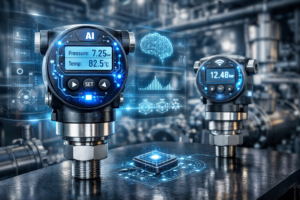
AI-Driven Precision: Redefining Measurement Accuracy for Pressure Transmitters
Every pressure transmitter has an important indicator at which it measures performance – that being Measurement accuracy – and being even slightly off (0.1%) can cause there to be problems with how we control processes or create product quality defects or safety issues within certain industries (such as oil and gas). While most gauge pressure transmitters utilize fixed analog compensation circuits to help improve accuracy by reducing drift (compensating for this drift with fixed circuits is not an effective strategy), these circuits also do not have the ability to adapt to changes associated with various types of pressure transmitters in realtime. The implementation of AI and specifically, using machine learning algorithms in relation to dynamically corrective (real-time) capabilities on smart pressure transmitters now creates a benchmark for overall accuracy within all industries.
Smart pressure transmitters which integrate modern AI technology use embedded high-performance microprocessor(s) and multi-sensor data fusion enable them to gather additional data about pressure in addition to other parameters (temperatures outside the range of operation, viscosity of the material being sent, changes in voltage) . AI models developed using large data sets of past measurements as well as information on different environmental conditions will be able to make predictions and compensate for errors that occur as a result of these variations in real-time. For example, an AI-enhanced smart pressure transmitter at a petrochemical refinery covers a large range of operating environments with temperature extremes of -40 °C to +125 °C. This model uses a long short-term memory (LSTM) network which allows it to adapt the shape of its compensation curves based on the current operating conditions with the aim of reducing the impact of temperature variations. Therefore, instead of incurring measurement errors of +/−0.5% FS due to temperature variations, it now has the ability to reduce those errors to +/−0.02% FS . Additionally, in high pressure natural gas pipelines, AI algorithms compensate for the inability of traditional gauge pressure transmitters to accurately account for the effect on accuracy caused by changes in the media compressibility factor due to changes in gas composition (variations in the density of natural gas).
A new area of development is AI assisted self-calibration of pressure sensors. Traditional pressure sensors need to be calibrated manually by taking the sensor to the site for calibration (a tedious and costly process that can impede production). In contrast, AI smart pressure transmitters can perform their own self-calibration by comparing actual measured readings to a model built on the basis of underlying physics and notified of deviations automatically , allowing for remote correction and continual maintenance of long-term measurement stability. Lower labor costs, less downtime and reduced procurement department costs for procurement engineers managing large-scale automated systems are all benefits of this technology.
Intelligent Diagnostics: From Passive Detection to Proactive Fault Identification
Industrial operations have been dealing with a serious problem regarding fault diagnosis for pressure transmitters. The traditional way that pressure transmitters operated is that they outputted the pressure reading for the process, which made it hard to determine whether or not an indication of a malfunction was due to the transmitter itself (sensor membrane damage, circuit noise or faulty wiring) or if it was actually a fluctuation in the process. This confusion often results in misdiagnosis, extended time needed for troubleshooting, and wasted money on unnecessary maintenance.
Due to this issue, AI has now been incorporated into smart pressure transmitters to allow them to become diagnostic devices. Smart pressure transmitters with AI now serve as proactive monitoring devices that can accurately identify, classify, and locate faults much quicker than previous technology.
AI diagnostics look for anomalies in the pressurized waveform signals and operational data, which may not be apparent to the human operator or conventional control systems. For instance, a spike in signal noise in conjunction with a gradual fading of linearity may suggest that there is wear on the sensor membrane. In contrast, when signals are dropping intermittently, this may indicate loose wiring or electromagnetic interference. Because of AI’s ability to analyse labelled fault datasets, AI can classify all of the different fault types more than 90 percent of the time, allowing maintenance teams to receive clear, actionable data rather than a vague alert.
In complicated industrial systems, AI-assisted pressure transmitters can provide a comprehensive diagnostic correlation between devices. For example, in a water treatment facility, if multiple smart pressure transmitters along the same pipeline section show a similar pressure anomaly, the AI system eliminates the individual device fault and identifies an overall possible leak in the pipeline—resulting in a time savings of up to 70% in diagnostics when compared to traditional techniques . For procurement engineer’s, this high degree of intelligence offers significant advantages by reducing unplanned downtime and guaranteeing that a facility adheres to very strict regulatory requirements (environmental standards in the chemical processing industry).
Predictive Maintenance: Shifting from Reactive to Proactive Asset Management
Companies that operate industrial facilities can lose hundreds of thousands of dollars every hour an unplanned disruption occurs due to a pressure transmitter failure. As such, it is necessary for procurement engineers to continuously look for ways of improving operational efficiency and TCO through methods such as AI-based predictive maintenance, which allows smart pressure transmitters to forecast failures, and therefore schedule repairs before they happen. Both reactive maintenance (fixing broken equipment when it fails) and preventive maintenance (scheduling checkups regardless of whether equipment was broken) are poor methods of maintaining equipment and reducing TCO because they create unnecessary costs for unnecessarily replacing parts and paying for labor to conduct the repair work.
AI systems analyze historical operational data, like pressure cycles, temperature exposure and vibration levels, to identify patterns of degradation and predict the remaining useful life of components of pressure transmitters. For example, based on subtle changes in the time it takes for the sensors to respond (due to fatigue in membranes) in a power plant boiler application, an AI system could send a maintenance alert 3–4 weeks prior to failure. This would allow maintenance teams to plan their repairs during the scheduled down period, thus avoiding costly disruption of production.
AI-powered predictive maintenance has been validated by many real-world case studies that show how valuable it can be in the workplace. In this case study, a European petrochemical company installed AI-enabled smart pressure transmitters at its refinery and was able to reduce the amount of time pressure measurements caused unplanned downtime by 40% and reduce their maintenance costs by 20% in the first year. In addition, natural gas pipeline companies have implemented AI predictive analytics and have decreased sensor-related failures by 90%, which has resulted in less gas leakage and greater safety. All of these results will help procurement engineers reduce lifecycle costs, increase asset reliability, and become more aligned with overall production goals.
Key Considerations for Procurement Engineers: Selecting AI-Enhanced Pressure Transmitters
Once procurement engineers have decided to incorporate AI technology into their pressure transmitters, they will assess three main considerations to ensure the device meets their operational requirements.
• Algorithm reliability – A priority is given to transmitters equipped with trained AI models based on datasets specific to the industry (for example, high temperature, corrosive media) to guarantee performance in an actual working environment; look for evidence of third-party testing/studies or applications with similar systems.
• Interoperability – Smart pressure transmitters must support all of the standardized industrial communications protocols such as HART, Foundation Fieldbus, and Profibus to allow these devices to be easily added into the existing PLC, DCS or SCADA. Compatibility with an IIoT platform is critical for centralized data analysis and remote management.
• Ruggedness – For operations in challenging industrial conditions, ruggedized designs (IP67/IP69K ratings, corrosion-resistant materials such as Hastelloy or tantalum), along with AI systems able to function reliably in extreme temperatures, pressures, and electromagnetic interference, should be a selection criterion.
Conclusion: AI as a Catalyst for Next-Generation Pressure Measurement
Pressure transmitter technology has changed significantly over time, and AI (Artificial Intelligence) is one of the latest developments in this field. Traditional gauge pressure transmitters are now being paired with advanced smart pressure transmitter technology. The combination of these technologies provides a more comprehensive approach to creating an industrially automated process.
Pressure transmitters with AI capabilities enable improved accuracy of measurements, allow for intelligent diagnostics of problems within the system, and provide a predictive mechanism for identifying when maintenance is necessary. Previously, pressure transmitters were used as passive measurement devices, whereas AI-based pressure transmitters will allow organizations to leverage the real-time information available from these devices to gain insight into their operations.
From a procurement perspective, using AI-enhanced pressure transmitters will yield significant cost savings due to reduced downtime and maintenance costs, plus the ability to increase reliability in processes within an increasingly competitive global environment.
As the evolution of AI and the Industrial Internet of Things (IIoT) continues, we will likely see more innovation in the design of pressure transmitters, including Edge AI processing that provides faster decision making and multi-variable predictive models, which will use correlation between pressure and all other process variables.
Procurers who wish to stay ahead of the game in their efforts to create automated systems must utilize resources that will allow for the development of resilient automation systems that are efficient and effective, thus enabling continued growth of their company’s success.
Previous: Emerson Rosemount 3051 Pressure Transmitter: Technical Review & Industrial Applications